A phase-gated, Part 103 electric flying wing
Designed for garage manufacture. Instrumented for technology maturation. The MUB-1R is a tailless, twin-motor electric ultralight moving through a disciplined, evidence-driven roadmap — already underway, not a concept.
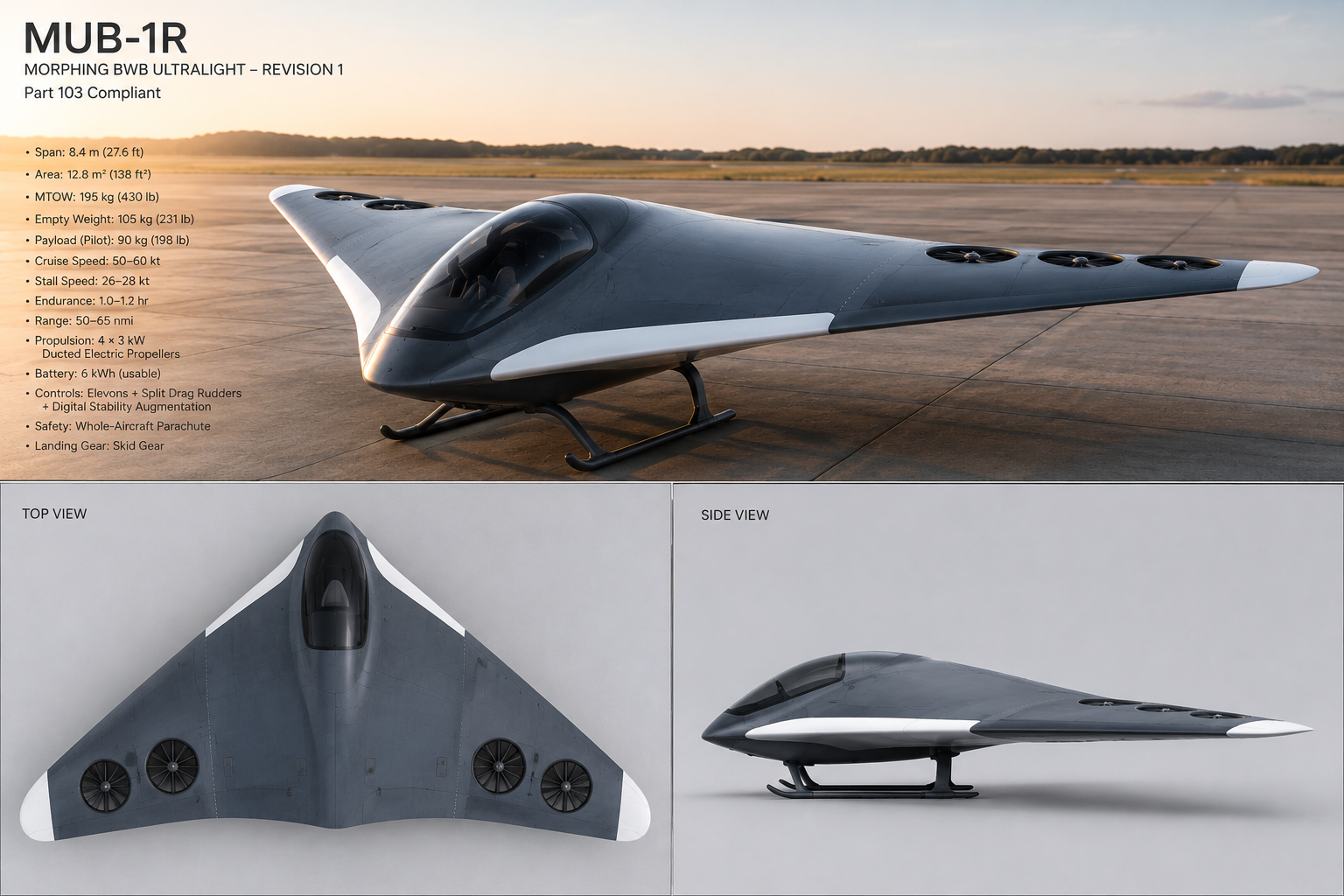
10.4 m
Wingspan
115 kg
Empty Weight
24 kt
Stall Speed
50–60 kt
Cruise
2×12 / 24 kW
Power
4.6 kWh
Battery
Program Overview
Every choice traces to: buildable, legal, survivable.
The MUB-1R develops a Part 103-legal, electric, tailless ultralight built with DIY-accessible methods, validated through incremental flight test, then progressively upgraded toward solar-extended cross-country capability — with an advanced-technology track maturing in parallel behind hard pass/fail gates.
Safety
Survivability cockpit cell with crushable core, 4-point harness anchored to spar fittings, dual redundant battery packs vented overboard, and a flight test program where every card carries written abort criteria.
Simplicity
Mechanical elevons and split drag rudders — no fly-by-wire, no software in the control loop. The flight computer logs and informs; it never flies the airplane.
Efficiency
A tailless flying wing with low wing loading, −5° washout, and a large solar-capable center body — the platform for solar-extended cross-country range, earned through measured data.
Manufacturability
Flat-panel composite construction: CNC-compatible, repairable, garage-buildable. Hot-wire foam cores, vacuum-bagged E-glass skins, carbon only where the loads demand it.
Part 103 Compliance
No certificate, no registration — a legal innovation sandbox. 115 kg empty, 24 kt stall, compliance documented with dated evidence and a pre-planned E-AB pivot path.
Two-Track Discipline
Track A flies a conservative manned aircraft first. Track B matures advanced tech — structural energy storage, BLI, morphing — behind quantified gates, graduating one at a time.
“The exotic technology never flies on an unproven airframe, and the pilot never flies on unproven technology.”
— The engineering thesis of the entire program
Technical Highlights
Conservative where it must be. Instrumented everywhere.
Every number below comes from the Master Design Package, the spar sizing document, and the honest battery math — conservative handbook allowables, stated hidden margins, and pre-declared descope ladders.
Airframe
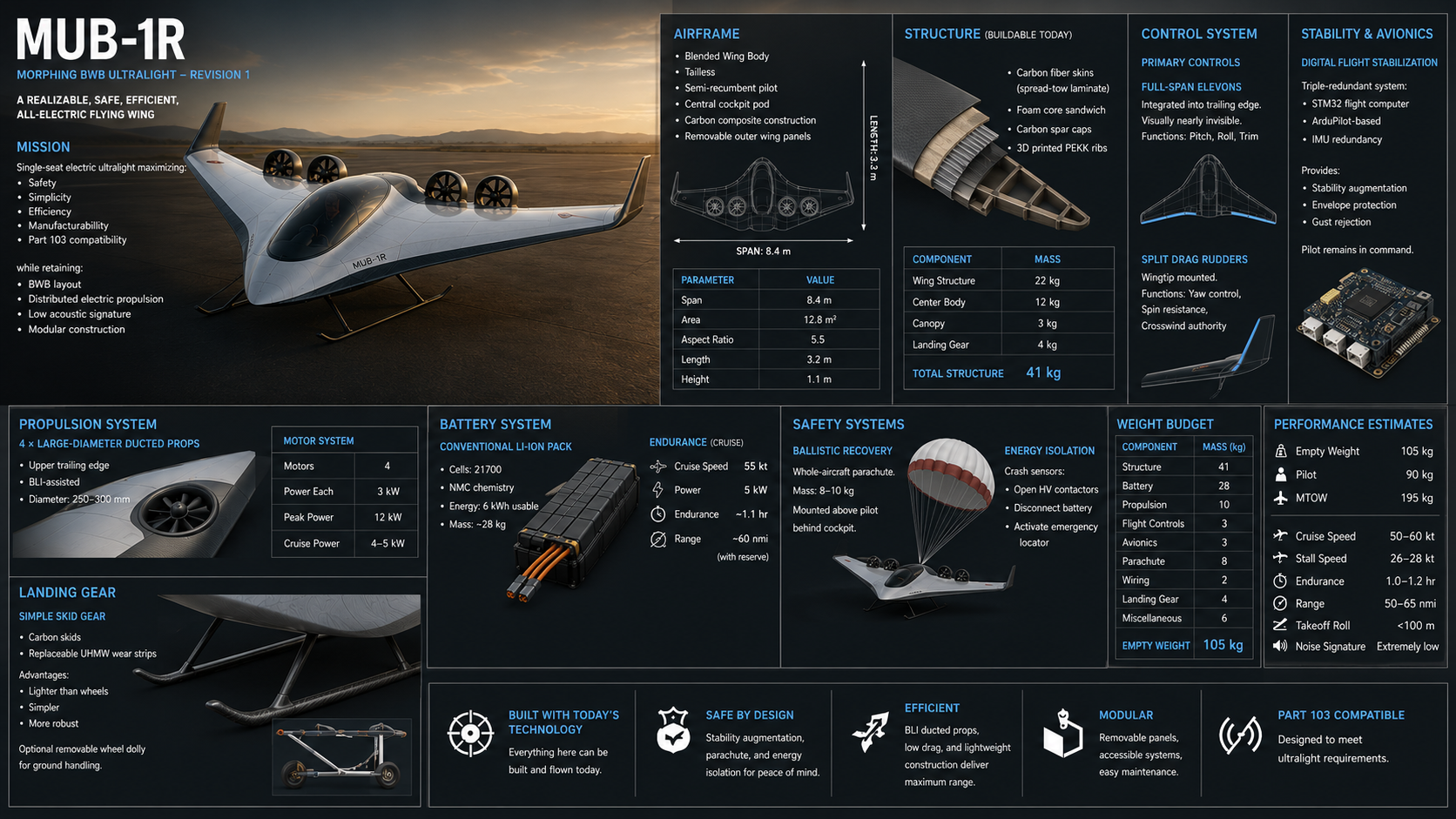
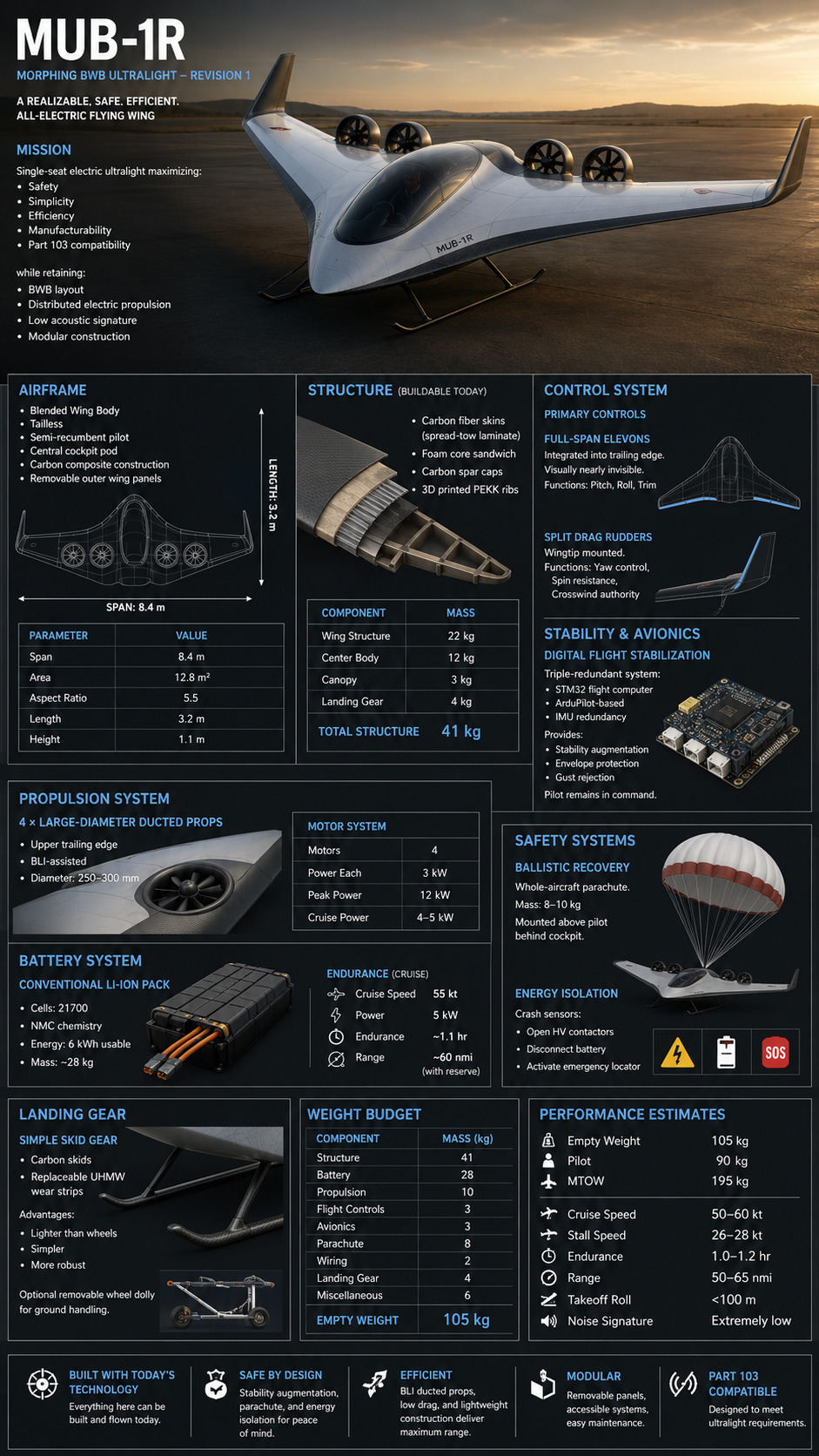
- Swept tailless flying wing — 10.4 m span, 19.5 m², AR 5.5, 20° sweep, −5° washout
- Three-module wing with 7075-T6 / 4130 pin fittings — bolted AND bonded, never adhesive-only
- Box spar: carbon uni caps, PVC foam shear web, ±45° glass wrap — carbon only where loads demand
- Foam-glass monocoque cockpit tub with 100 mm crushable core under the seat pan
Propulsion
- 2× 10–12 kW leading-edge-mounted electric outrunners on steel weldment hardpoints
- 200 A+ HV-class ESCs in ram-air cooled bays, pre-flight current-derated to 80%
- Single-lever throttle, both motors — differential thrust not used for control in Phase 1
- Asymmetric power characterized on the ground (Card 6) before it can happen airborne
Battery System
- 4.6 kWh, 16S Li-ion — two physically separated packs, independent contactors and fusing per pack
- Molicel P45B-class cylindrical cells — inherently more runaway-resistant than pouch
- Cell-level BMS with pilot-visible alarm; enclosures vented overboard, never into the cockpit
- Packs mounted behind the spar carry-through, outside the cockpit crush zone
Controls
- Mechanical elevons via pushrods and bellcranks — adjustable rod ends for reflex/differential tuning
- Split drag rudders on cable runs with 5° crack-open preload capability
- Digital stability augmentation — enhancing handling without replacing pilot authority
- Total system freeplay < 1 mm at trailing edge — flutter discipline, non-negotiable
- Elevons mass-balanced to 100% static balance; no mass on control surfaces, ever
Safety Systems
- 4-point harness anchored through to spar carry-through fittings, not shell laminate
- Pixhawk-class flight computer providing digital stability augmentation and full telemetry logging
- Whole-aircraft parachute + helmet mandatory for all flight operations
- Vne set at 1.4× max demonstrated — never demonstrated-to-find
Performance
- Stall 24 kt (MH-78, usable CLmax ≈ 1.15 with reflex + washout + DIY roughness) — honestly computed
- Cruise 50–60 kt; cruise power quoted as a range, measured in Phase 1D
- Endurance ~1.0–1.2 hr at cruise; range 50–65 nmi
- Gust alleviation Kg ≈ 0.26 — the airplane rides gusts rather than fighting them
Key Specifications
Weight Budget — The Honest Ledger
Revised honest masses (kg). Battery descope to 3.8 kWh is a pre-approved hard gate in Phase 1C: 114.2 kg empty, back under the 115 kg Part 103 limit.
Mass (kg)
Structural Margin Summary — beyond the ×1.5 ultimate factor
+4.4g / −2.2g limit · 6.6g ultimate. Hidden conservatisms stated, not spent: elliptical distribution, wing mass relief ignored (~8%), compression allowable knocked down 60% from datasheet.
| Element | Governing Case | Margin of Safety | Retired By |
|---|---|---|---|
| Carbon spar caps, root | +4.4g maneuver | +0.12 | Proof test + coupon |
| Shear web | Root shear | +1.6 | Proof test |
| Wing-join pins (10 mm 4130) | Moment couple | +1.4 | Specimen-to-failure |
| Fitting bearing (7075-T6) | Moment couple | +1.8 | Specimen-to-failure |
| Skin torsion (D-tube) | Rolling pull-out | Large | Twist-stiffness check |
Program Roadmap
No phase begins until the previous gate passes.
~$9,900 through first flight · $16–18k through Phase 3 · 9–14 months part-time to first flight. The gates are contractual — with the builder, and with any partner.
Foundation
In Progress$1,400 · 6–8 wksWorkshop setup, hot-wire cutter, process coupons, 1/4-scale flying model
EXIT GATE: Model flies predictably; coupon tests pass
Cockpit Cell + Center Section
$2,200 · 8–10 wksFoam-glass monocoque survivability tub, box spar carry-through, motor hardpoints
EXIT GATE: Static load proof test pass (4.85g equiv., 3-min hold)
Wings, Controls, Gear
$2,800 · 10–12 wksWing panels with −5° washout, mass-balanced elevons, split drag rudders, skid gear
EXIT GATE: Rigging + weight audit ≤ 115 kg
Propulsion + Avionics
$3,000 · 4–6 wksTwin outrunners, dual redundant 16S packs, Pixhawk-class FC with digital stability augmentation
EXIT GATE: Full-power ground run; W&B in CG box (10–12% SM)
Flight Test Campaign
$500 · 8–12 wks18-card test program: taxi → crow hops → first flight → envelope expansion
EXIT GATE: 10 hr envelope logged; measured cruise power known
Ground Solar Infrastructure
$2,000 · parallelFolding 2–3 kW ground solar array + buffer bank + charger — zero flight-weight penalty
EXIT GATE: Measured cruise power known
Airborne Solar
$3,000–4,500 · 8 wksCenter-section array first: 3–4 m², Maxeon-class cells, 4+ MPPT channels, 3 kg
EXIT GATE: Coupon thermal test pass; measured cruise ≤ 5.5 kW
Soaring Operations
$1,200 · 6 wksFolding props, ArduPilot soaring library in advisory mode, cross-country doctrine
EXIT GATE: Cross-country capable
Track B Technology Gates
$2,000–3,000 · as fundedRib-pack energy storage / BLI rig / SMA morphing bench — parallel, optional, as funded
EXIT GATE: Quantified pass/fail gates per Rev B analysis
Phase 1D — Flight Test Discipline
Eighteen cards in strict sequence. One objective per card. Abort criteria written before flight. Knock-it-off authority for pilot or observer, no justification required. Maximum 3 cards per day — 2 if anything surprised you.
BLOCK A · Cards 1–6
Ground
Taxi familiarization, drag-rudder ground authority, high-speed taxi with vibration survey, nose-light runs, abort rehearsal, asymmetric power characterization.
BLOCK B · Cards 7–10
Crow Hops
First lift-off below 1 m, sustained hops, gentle control doublets (first R-14 checkpoint vs model prediction), simulated power loss at 2 m. Exit: 5+ sessions, written observer concurrence.
BLOCK C · Cards 11–14
First Flight & Initial Envelope
First flight with mandatory chase observer, trim & stability survey at 2,000+ ft, slow flight in 2 kt steps, stall characterization at 3,000+ ft — second R-14 checkpoint documented same-day.
BLOCK D · Cards 15–18
Envelope Expansion
Deliberately skeletal until Block C data exists — speed expansion to Vne, maneuvering to 2g, single-motor-out, and the R-07 cruise-power deliverable that gates all of Phase 2.
Track B — Advanced Technology Gates
Parallel, optional, as funded. Survivors graduate onto the flight-proven MUB-1R as Phase 4 experiments — one technology at a time, never stacked.
| Experiment | Cost | Quantified Gate | On Fail |
|---|---|---|---|
| Rib-pack structural energy panel | $1,200 | ≥ 165 Wh/kg installed with structural credit, load-tested to limit (set above the current published ceiling — expected to fail; conventional-pack fallback is the plan) | Conventional packs stand |
| BLI duct rig (truck/ground) | $400–800 | ≥ 5% net propulsive benefit vs podded baseline incl. distortion + weight | Podded props stand |
| SMA camber morphing bench | $600 | Secondary/trim role only — primary control pre-failed on bandwidth | Conventional surfaces stand |
Risk Management
Fourteen named risks. Zero hidden ones.
Risk Score = Likelihood × Severity. Anything ≥ 12 requires an active mitigation with a named verification step; anything with Severity 5 requires mitigation regardless of likelihood. Three safety-critical risks honestly carry residuals of 10 — because they can only be retired by flight test itself.
Pre-Mitigation vs Residual Risk (Register Rev B — the honesty pass)
The largest residual risk is the pilot — and the program says so out loud. R-04 (pilot proficiency) is historically the #1 killer in amateur-built first flights. The mitigation is a written pilot dossier: dual instruction in a conventional ultralight, glider time for energy management, a minimum of five crow-hop sessions, and hard personal minimums signed before the airplane is finished — when judgment is uncontaminated by impatience.
Pressure-Tested
The design package was subjected to a skeptical chief engineer review — systems, structures, aerodynamics, program. These are the hardest questions asked, and the corrected, on-the-record answers.
Investment & Partnership
Specific, bounded, tiered asks.
Companies say yes to small concrete things and no to vague big ones. Tier 1 is the actual ask — Tiers 2 and 3 exist so a partner can volunteer upward as confidence builds.
Tier 1
Engineering Review
The primary ask
- Engineering design review of the spar & wing-join package
- Periodic technical mentorship
- FEA review of classical beam analysis (invited)
Lowest cost to partner — highest leverage to the program. A flaw found on paper costs nothing; the same flaw found in flight costs everything.
Discuss Tier 1Tier 2
Manufacturing Support
Bounded & concrete
- CNC / shop time for the flat-panel kit
- Composite consumables at cost
- Process guidance on vacuum-bagged layups
Directly accelerates Phases 1A–1C and tightens the weight budget — the most likely serious program risk.
Discuss Tier 2Tier 3
Program Partnership
If mutual interest develops
- Instrumentation support for Track B gate experiments
- Flight test facility access
- First position on Track B technologies that pass their gates
A documented, instrumented testbed for low-Reynolds electric flight data — plus defined IP position and co-publication options.
Discuss Tier 3What a partner gets
Instrumented Testbed
A documented, instrumented testbed for low-Reynolds electric flight data — every flight logged from day one.
Genuine PR Value
Association with a disciplined grassroots program — real credibility in the light-aviation world.
Track B First Position
First position on rib-pack energy storage, BLI, and morphing technologies if any pass their quantified gates.
Defined IP Position
Builder retains airframe design rights; partner receives negotiable data access, co-publication, or license options on jointly developed elements.
“The airplane is already underway. The question is whether it flies with your fingerprints on it.”
Back the Program
Fund it. Review it. Build it with us.
Whether you represent an aerospace partner, want to support the program financially, or simply want to follow the build — send a note. Every inquiry is read by the founder.
J Manchester
Founder & Designer
Solo creator of the MUB-1R program — currently seeking manufacturing partners, engineering reviewers, and funding to carry the aircraft through its phase gates to first flight.
Ask precisely, answer honestly. If you ask something the program doesn't know yet, you'll hear: “I don't know — that's exactly the kind of question I want a partner for.”
Engineering-First Communication
All inquiries are read and answered personally by the founder. Expect honest, technically grounded responses.
Transparent Program Status
Phase 0 is actively underway. The program is past concept — tooling is built, coupons are being tested.